Training Your Parrot: Tricks, Words and Trust
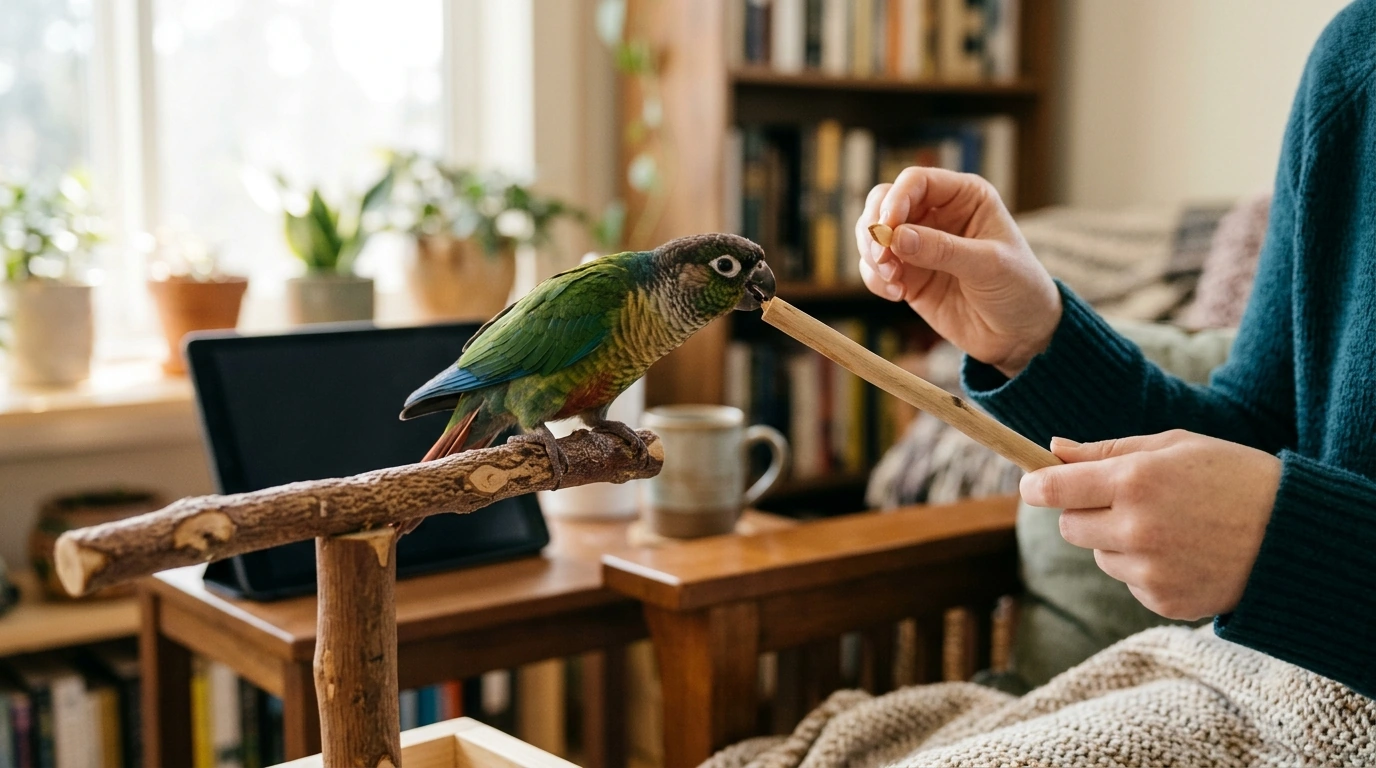
Training your parrot starts with listening. A bird that feels comfortable has more opportunity to explore, make choices, and learn alongside you. Our Training Your Parrot digital guide and checklist offers a place to organize practice as you work on tricks, words, and communication.
Every parrot progresses differently. Some approach a new activity quickly, while others need more time to feel secure. We recommend celebrating small signs of curiosity and letting your bird set the pace.
Start with trust and a comfortable routine
Choose a quiet, familiar spot where your parrot can focus without frequent interruptions. Keep sessions short and finish while your bird is still interested. A few calm minutes can be more productive than a longer session that leaves either of you frustrated.
Watch your parrot’s posture, movement, and vocalizations. Moving away, freezing, lunging, or showing other changes from its usual relaxed behavior may mean it needs space. Pause and give your bird room rather than forcing it to stay or participate. Learning its individual signals takes time, and those signals are useful information.
Positive reinforcement means following an action you want to encourage with something your bird values. That might be a small, bird-safe treat or praise if your parrot enjoys it. Offer the reward promptly so the connection between the action and the reward is clear. Keep treats small and account for them as part of your bird’s overall diet.
Choose a first skill and build it gradually
Start with one skill and make the first request easy. For step up, offer a stable hand or handheld perch near your parrot without pressing it against the bird. Reward a voluntary movement toward it, then gradually reward a foot placed on it and, eventually, a full step. If your bird moves away, increase the distance and try an easier step later.
Target training is another useful starting point. Present a target stick within comfortable reach and reward your parrot for looking toward it. As your bird becomes comfortable, reward movement toward the target and then a gentle touch. You can use the target to invite movement without pushing or grabbing your bird.
Practice one small step at a time, and be consistent about which response earns a reward. If a step seems difficult, return to an easier one rather than repeating a request your bird is avoiding.
Simple starting points for parrot training
| Skill | First step | Reward opportunity |
|---|---|---|
| Step up | Offer a stable hand or perch near the bird | Reward a voluntary step onto it |
| Target | Present a target stick within comfortable reach | Reward a look toward or touch of the target |
| Words | Repeat a short phrase in a relevant situation | Reward attentive or vocal responses |
Encourage words and two-way communication
If you would like to encourage speech, choose a short, clear phrase and repeat it in the same situation. For example, you might say “good morning” when you greet your bird. Reward attention or a vocal response your parrot offers, without demanding an imitation. Talking ability varies by species and individual, and not every parrot will learn words.
Communication also includes posture, movement, and sounds. Notice when your bird approaches, turns away, relaxes, or calls to you. These responses can help you understand preferences and adjust your routine. Avoid punishing unwanted sounds; instead, notice and reinforce a behavior you would like to hear or see more often.
For guidance on reward-based approaches, see the American Veterinary Society of Animal Behavior’s position statements. An avian veterinarian can also help when a change in behavior raises a health concern; the Association of Avian Veterinarians offers resources for bird owners.
Use a checklist and AI tools thoughtfully
After each session, write down the skill you practiced, your bird’s response, and the next small step. For example: “Target: looked at stick from a comfortable distance. Next time, reward a lean toward it.” Notes like these can make gradual progress easier to recognize and help you avoid moving too fast.
You can ask an AI tool to organize your notes or suggest a simple practice schedule. For instance, provide a summary of several short sessions and ask for a checklist of possible next steps. Treat the result as a draft, not a substitute for observing your bird. Check AI-generated advice with an avian veterinarian or qualified bird behavior professional, especially when health or safety is involved.
Explore the Training Your Parrot digital guide
Our Training Your Parrot digital guide and checklist brings together an eBook and checklist for bird owners interested in tricks, words, communication, and AI tools. It is listed at $12.99 USD.
If you are still considering which pet might suit your household, our Purrfect Match digital guide explores using AI to help with that decision. For a parrot already in your care, start with one comfortable interaction and build from there, at your bird’s pace.
Compare related options such as Pet Feeding Tracker Checklist | Printable Pet Care Planner | Digital Pet Feeding Schedule | Pet Food Log for Cats & Dogs | Pet Routine Organizer (Digital Download) to match features, dimensions, and use case before choosing.
FAQ
How long should a parrot training session be?
Keep sessions short, adjusting to your bird’s attention and comfort. Stop or take a break if your parrot shows signs of stress.
Can every parrot learn to talk?
No. Talking ability varies among species and individual birds, and parrots also communicate through sounds, posture, and other behaviors.
Can AI train my parrot for me?
No. AI can help organize ideas or practice notes, but you need to observe your bird and use safe, positive training methods.







Leave a comment