Practical AI Workflow Tips for Healthcare Teams

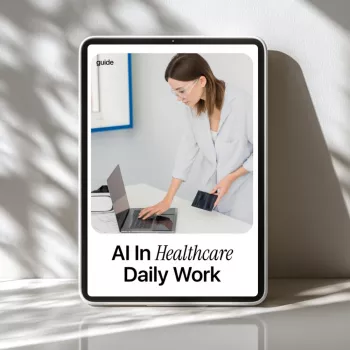
AI can help healthcare teams explore new ways to manage routine work, but useful workflows still depend on people. Our AI in Healthcare Daily Work Guide is a $9.99 digital resource for medical teams interested in practical AI workflow tips. We recommend starting cautiously: choose a non-clinical task, protect sensitive information, and keep a team member responsible for the final result.
Where AI Can Fit Into Daily Work
Healthcare teams handle many administrative tasks alongside their clinical responsibilities. An AI tool might help draft a general meeting agenda, organize a routine task list, or summarize non-sensitive material for a team discussion. These uses can give you a starting draft to edit rather than a finished product to accept automatically.
For example, you could provide a list of general meeting topics and ask for a proposed agenda with time blocks. Your team can then adjust the order, add missing items, and decide how much discussion each topic needs. You might also use AI to group a list of routine tasks by project or deadline, provided the information you enter complies with your organization’s policies.
Keep these examples separate from patient-specific diagnosis, treatment, and clinical decision-making. Our guide is a practical starting point for considering workflow improvements, not a substitute for qualified staff or established clinical processes.
Start With One Low-Risk Workflow
You do not need to change an entire department’s process to explore whether AI is useful. Pick one repetitive, non-clinical task with a clear beginning and end. A recurring team meeting or a general notice may be easier to evaluate than a complicated process involving multiple systems.
Before testing, decide what a useful result would look like. For an agenda, that could mean covering all supplied topics in a logical order and leaving time for questions. For a task list, it might mean making responsibilities and deadlines easier to review. Use fictional or non-sensitive information in your test, and assign a team member to check the output.
Examples of Low-Risk Starting Points
| Task | Possible AI use | Human check |
|---|---|---|
| Team meeting | Draft an agenda from non-sensitive topics | Confirm priorities and accuracy |
| General communications | Draft a non-patient-specific notice | Review wording and organizational policies |
| Task planning | Organize a list of routine tasks | Adjust responsibilities and deadlines |
Once you have a draft, compare the AI-assisted process with your existing workflow. Consider how long it took to prepare the input, review the result, and make corrections—not just how quickly the tool generated text. If the draft creates extra work or misses important context, revise your approach or continue with the existing process.
It can also help to agree on a simple review routine. Identify who supplies the information, who checks the draft, and who approves it for use. This makes the experiment easier to repeat and gives your team a clear point at which to stop if something seems unsuitable.
Protect Privacy and Keep People in Control
Before entering any information into an AI tool, follow your organization’s policies and applicable privacy requirements. Do not enter identifiable patient information unless your organization has authorized the specific tool and use, and appropriate privacy and security safeguards are in place. When you are unsure, pause and consult the appropriate privacy, security, or compliance team.
Non-sensitive input is a sensible starting point, but it does not remove the need for review. AI-generated text can contain errors, biased assumptions, or wording that does not fit your organization’s policies. Read it carefully before sharing it, and verify any factual statements against reliable sources. Qualified staff remain responsible for decisions and for material they approve.
For broader guidance, the NIST AI Risk Management Framework provides a framework for managing AI risks, while the HHS health information privacy resource explains federal health information privacy requirements.
A Guide for Exploring Practical AI Workflows
Our AI in Healthcare Daily Work Guide is a digital download listed at $9.99. It is intended for medical teams interested in practical AI workflow tips and offers a starting point for conversations about where a tool might fit into everyday work.
If you are also reviewing your broader approach to planning and routines, our Ultimate Productivity Blueprint is a separate digital productivity guide listed at $14.99. It focuses on goal setting, time management, and daily routines rather than healthcare-specific AI use.
We suggest choosing one suitable task, reviewing the result with your team, and deciding whether the process genuinely helps. Build any ongoing workflow around team oversight, clear responsibilities, and your organization’s rules.
Before choosing, compare the product details with your daily routine, available space, care needs, and preferred setup. The strongest option is usually the one that fits the intended use clearly and remains simple to clean, store, and check before repeat use.
Compare related options such as Pet Feeding Tracker Checklist | Printable Pet Care Planner | Digital Pet Feeding Schedule | Pet Food Log for Cats & Dogs | Pet Routine Organizer (Digital Download) to match features, dimensions, and use case before choosing.
FAQ
Can healthcare teams use AI for administrative work?
Yes, depending on organizational policies and the tool used. Start with non-sensitive tasks and have a team member review outputs before use.
Should patient information be entered into an AI tool?
Only when your organization has authorized the tool and the specific use, and appropriate privacy and security safeguards are in place.
Is the AI in Healthcare Daily Work Guide a physical book?
No. The guide is listed as a digital download.











Leave a comment